
A practical framework for becoming visible, understandable, and trustworthy in AI search.
The Ksenai AI Visibility Framework helps evaluate whether AI systems can understand what a company does, when it should be mentioned, how it compares with competitors, and why it can be trusted.
Visibility
From keywords to customer questions and AI answers.
Traditional SEO starts with the queries people type and how pages rank. AI visibility adds a second question: when customers ask AI for advice, comparisons, or recommendations, does your company appear in the answer, and is it described correctly?
AI visibility depends on five connected layers.
Each layer supports one or more of three goals. Measurement sits underneath: it shows where you stand and what changed. The Ksenai AO Engine checks every layer.
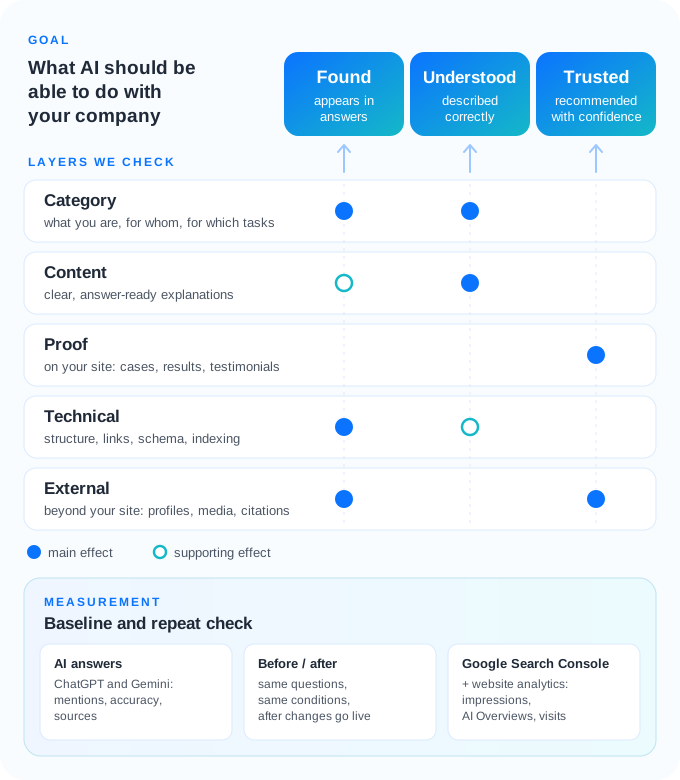
What we look at, and what usually changes.
Category - what you are
What we look at: Category language, services, audiences, and use cases.
An audit may show: The category, audience, or offer is explained inconsistently across pages.
Typical action: Clearer service definitions, page headings, category and comparison language.
Content - clear answers
What we look at: Direct answers to client questions, FAQ, answer-ready formats that are easy to quote.
An audit may show: Important questions are not answered directly, or useful knowledge is scattered across the site.
Typical action: FAQ and answer blocks, question-based sections, clearer service pages.
Proof - evidence on your site
What we look at: Expertise, credentials, client examples, testimonials, outcomes.
An audit may show: Claims exist, but the evidence behind them is hard to find or interpret.
Typical action: Proof blocks, case evidence, visible expertise signals.
Technical - readable structure
What we look at: Page structure, headings, internal links, canonical signals, schema, indexing.
An audit may show: Structure, links, or schema are not clear enough for search engines and AI systems.
Typical action: Heading hierarchy, internal linking, schema, indexing and accessibility fixes.
External - signals beyond your site
What we look at: Profiles, directories, media mentions, reviews, and other public references.
An audit may show: Public sources do not support the positioning you want.
Typical action: An external source plan: which profiles, reviews, or references to build first.
Measurement - baseline and repeat check
What we look at: An approved question set, answers from ChatGPT and Gemini, cited sources, competitors, before/after comparison.
An audit may show: There is no baseline for AI answers, brand mentions, or competitor context.
Typical action: A baseline now, and a follow-up review after changes go live.
Three complementary layers show different parts of the AI search journey.
No single source captures the complete path from appearing in an AI or search experience to a person visiting the website. Ksenai brings the available layers together without treating them as interchangeable.
Google Search Console
Measures visibility in Google Search, including dedicated reporting on impressions in Google's generative AI features, such as AI Overviews and AI Mode.
Website analytics
Shows visits and on-site actions after someone clicks through from a search result or an AI answer, when identifiable referral data is available.
Ksenai AO Engine
Our in-house system of AI agents. It checks the site itself (pages, structure, schema, internal links), collects answers from ChatGPT and Gemini to an approved set of client questions and reviews presence, accuracy, cited sources and competitors, adds imported external evidence, and compares results before and after changes.
The framework turns AI search uncertainty into a practical roadmap.
The framework can be applied at different levels of depth - from a focused audit of initial visibility gaps to an extended audit with broader question sets, competitor comparisons, quantitative measurement, and repeatable baselines across selected AI platforms.
Test real questions
We define representative questions that potential customers, partners, or decision-makers may ask AI systems.
Review AI answers
Does AI mention the company? Does it understand what you do? Does it trust the information? We check where you appear, how you are described, what is missing, and which competitors are mentioned.
What should improve first?
Which website, content, FAQ, proof, or positioning changes are likely to have the highest practical value? Findings become a prioritised action plan.
Implement and measure again
Agreed changes are implemented directly or with your team. After they go live, a follow-up review compares results with the original baseline and updates the next priorities.